
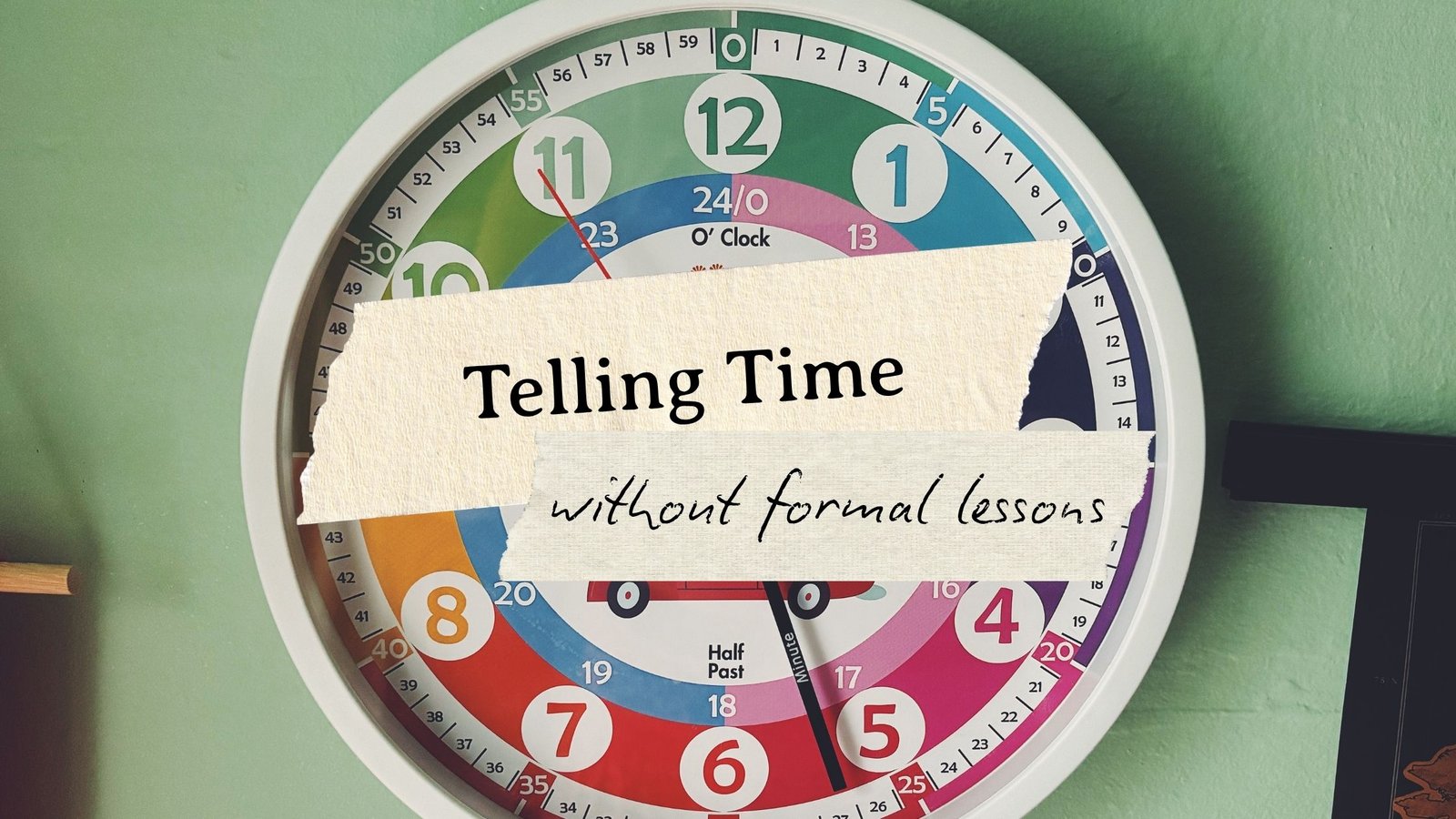
Our girl loves time. So much so that, I confess, I’m sometimes annoyed at how much she keeps track of it if we’re running a little behind and I’m being notified of how many minutes remain until we arrive.
But…count it all joy! Yay! She can tell time!
She’s 7 and she’s been learning to tell time on standard 12-hour and full-day 24-hour clocks since she was about 5, without me spending very much time actively teaching about it.
One of the biggest reasons I started this blog was to help others see how much can be learned by way of how we design environments, structure daily tasks, and play.
I also looooove worksheets. So color me a weirdo. Unless you’re like me. Then welcome!
I’m looking to make things as painless as possible (unless pain is the only way to learn it, or pain comes without asking and then we will figure it out). I don’t want everything to have to be a sit down lesson with a full blown curriculum.
I’d rather weave learning into our daily rhythms so that the “why” of what’s important explains itself and the practice walks out naturally as we move through the days.
Teaching Kids to Tell Time Through Everyday Life
You know your kids. You know if any of them struggle more with numbers or if there is a special consideration in the mix. All that aside, I think we should expose children to time from the very beginning. When it clicks, it clicks. For our daughter, she understood military time between four and five years old, could read an analog clock with pretty consistent accuracy by six, and can do time math of her own volition now, at seven. None of it with 100% accuracy yet, but she’s very rarely mistaken.
Here’s how I did it.
Step 1: Set up helpful clocks around your home.
You may look at this list and ask, “Why so many clocks?” I think we have so many clocks for a variety of reasons. We like the look of them, they can be a useful piece that adds to the decor, and they help teach kiddos time. It’s also one less reason to reach for my phone during the day. Make sure that these are mainstay clocks, rather than clocks relegated to less-traveled areas of the house. This repeated exposure in different contexts helps them process and experience time throughout the day over and over, and their brains start to note patterns without us needing to verbalize them (they do this for all kinds of things in life already!).
a 24-Hour Analog Clock
You can get one on Amazon for the same cost as a 12-hour one. We have a spiffy one we bought for one of our anniversaries, which is honestly how I really got the hang of military time (my veteran husband already had it down).
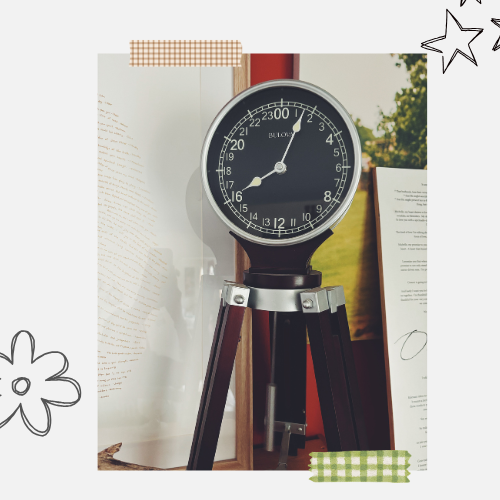
Our 24-hour analog sits in our living room, where we spend a lot of family time. When our daughter wanted to know what time it was while in the living room, we didn’t use our phones. We turned to the 24-hour clock and walked her through what time it was by starting with “It’s 16:03.” Be assured that she did not understand the clock right away. It took her several years but bit by bit, her mind wrapped around the logic of it and now she can read a 24-hour analog without hesitation. Just by exposure, and by us walking through its use with her.
A 24-hour digital clock
We set the stove clock to 24 hour time so there is a military time digital for easy wins. This is a clock in a very common, accessible space. Because it’s the only digital clock on this list, she also preferred it more than any of the others while learning to tell time. Since it was the easiest because it literally just says the time, but it’s a 24-hour clock, this clock had her converting 24-hour time to 12-hour time. Now, military and standard time are like two languages in her head.
An educational clock
This is the one we used during our morning homeschool hour for structured time-telling practice.
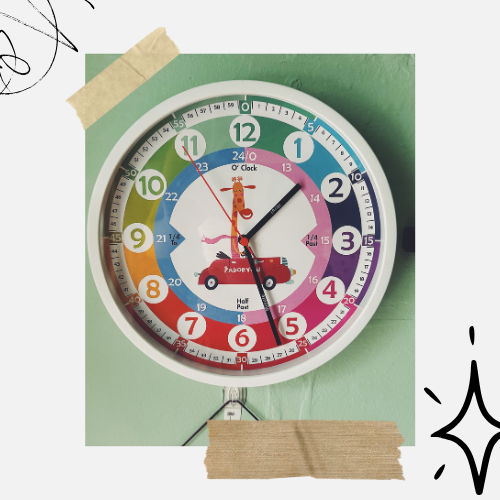
I can no longer find the lovely one I bought, but I did find some close equivalents here and here. You’re looking for a clock that visualizes each hour’s ‘region’ of the clock and includes other common time-related vocabulary such as, “half past” and “minute hand.”
In our clock below you’ll see that the 12 is the same color as a colored band between the 12 and the 1. This is important because one of the most common mistakes children make is assuming that once the hour hand passes a number, you’re in the next hour. Kids will think it’s 2:55 because the hour hand is touching the tip of the 2 and not the 1 because of how close to 2 o’clock we are.
A clock without numbers (or with fewer numbers)
The ultimate test. The least favorite. Incredibly valuable. This one maintains the pattern they see elsewhere but requires them to internalize time in a deeper way.
You can go super hardcore and get something like this, or choose a clock with hour markers. Even a clock that only has 12, 3, 6, and 9 can work.
Step 2: Use GPS to practice time in real life.
We’ve been asking, “Are we there yet?” as a human race for a very long time. I value the ability to navigate my roads without GPS and actually paying attention to the names of roads and the directions GPS offers so you don’t need it next time. Very good skills. However, with littles learning time, using GPS more than you need to can be beneficial.
They will already be looking at the car screen to see how many minutes are left. They will already notice the Time of Arrival listed.
You can strike up great mini conversations about time by using GPS. What’s great is the GPS lists both how much time remains and what time it will be when we arrive. The answers are right there. You can say, “The GPS predicts we will get there in 15 minutes. What time will we get there?”
It’s ok that they just need to look at the answer on the GPS. Remember, we all learn through repetition and observation, especially when we genuinely care about the answer. Up front, they may look to see that means they will get there at 3:45, but after months of exposure, they may just know that 3:42 plus 15 minutes is 3:57 and it’ll be an exciting moment for you!
This shows how time is useful in everyday life while planning trips and meeting with people.
Step 3: Pick a Workbook, Any Workbook
I introduced step three a while after steps one and two so that I planted easy wins through familiarity first, and then when we sat down with worksheets, she was not starting at zero. By the time I introduced step 3, she knew time vocabulary from natural conversation, which removed the barrier of new language from the lesson. The goal isn’t to avoid formal teaching. It’s to avoid starting with formal teaching.
Grab a $3 workbook like this one from School Zone and have a blast.
I will say that I have had great experiences with multi-subject workbooks from Brain Quest and School Zone. Both companies’ Kindergarten workbooks include time and many other subjects, which can be more cost effective. It depends on what curriculums you have decided to roll with. I’m an eclectic homeschooler, I grab what works. These served us well for our first rodeo.
One to two time worksheets per week should suffice. Memory consolidation is real and it’s amazing to watch a kid that looked at something on Monday understand it in a whole new way by Thursday or Friday. So, we did time 1-2 times per week to reduce pressure but help practice in a controlled environment.
Step 4: Let the concepts build naturally.
This process can be conversational and take days or weeks to walk through at a pace you sense works for your children. It can even happen cuddled up on the couch, pointing to a clock on the mantle. Now the formal needs start identifying themselves.
Does your child understand the concepts of Early Morning, Morning, Noon, Afternoon, Evening, and Night?
The idea of hours and minutes?
Which hand tells us what?
I liked showing that the minute hand “pulls” the hour hand with it until it gets to the next hour by setting a clock and letting her see the hands move at an exaggerated speed.
I peppered in counting by fives to our daily rhythm. This helps with time, too.
Focus on getting your children to learn to tell time literally. Don’t worry about “half pasts” and “quarter of” just yet. That comes. Once they can read an analog clock, the language will follow. As they understand how to count by fives, to add and subtract, they will learn how to work time problems out in their head.
The goal isn’t to make telling time another thing your child has to sit down and master. Let them see it. Talk about it. Use it. Give them reasons to need it. Then, when it’s time for a little more focused practice, they’re refining something they already understand.
Exposure, exposure, exposure.
Step 5: Don’t Stress!
Until a real need to focus more on a subject arises, there’s no point putting too much pressure or emphasis on getting it squared away in a certain time frame. If my post seems less structured than you’re comfortable with, I understand. My method is a great supplement for you even if you prefer a ton of structure, and can inspire those who even lean more toward the unschooling crowd. I’m a fan of aspects of both, and consider myself an eclectic educator if a label is needed.
What ways do you weave telling time into the day? I’d love to hear in the comments.
If this post was useful, you would be doing me a huge solid by sharing wherever you think it’ll make the most impact!
♡, Michelle







Leave a Reply
You must be logged in to post a comment.